
In commercial flour milling, the margin between premium patent flour and lower-grade standard output often comes down to a fraction of a percent in ash content. This tiny difference translates directly into massive shifts in daily mill profitability.
While roller mills handle the mechanical reduction process, the Purifier acts as the critical quality-control checkpoint. It strictly determines whether pure endosperm is successfully isolated or fatally contaminated by bran and composite stock. Failing to separate these distinct streams correctly ruins final product consistency and brand reputation.
For mill operators evaluating facility upgrades, understanding the mechanics of stratification is essential. We will explore the severe risks of improper calibration alongside the strict benchmarks for extraction rates to protect your margins. You will learn the exact operational mechanics behind particle separation and discover actionable criteria for selecting your next equipment upgrade.
**Quality Metrics:** Effective purification directly lowers ash content (targeting ~0.40% for patent flour) by preventing microscopic bran contamination.
**Operational Mechanics:** Modern purifiers rely on a precise triad of forces—controlled aspiration, mechanical sifting, and vibratory stratification—to separate particles by density and size.
**Risk Mitigation:** Proper calibration prevents oversifting (which increases ash) and undersifting (which causes yield loss to subsequent break systems).
**Buyer Evaluation:** Selecting the right equipment requires assessing variable airflow controls, sieve frame modularity, and sanitation features.
Commercial milling operations revolve around managing distinct particle streams. You must accurately categorize the material entering your purification stage. We typically frame the central problem of milling as managing three distinct stock profiles.
Pure Endosperm: This is high-density, high-value material. You route it directly to the reduction rolls for final grinding.
Composite Stock: This consists of endosperm chunks attached to bran pieces. It requires further processing through sizing or break systems.
Bran: This is lightweight, flaky material. You must entirely remove it to prevent severe contamination in your final product.
Ash content serves as the ultimate measure of separation success. It effectively quantifies the mineral residue left after combustion. Bran contains significantly higher mineral levels compared to the endosperm. Excess ash clearly indicates bran contamination. This contamination darkens flour color. It also significantly compromises gluten strength. High-quality patent flour targets an ash content of approximately 0.40%.
Thorough purification delivers a profound downstream economic impact. It dramatically reduces mechanical stress on subsequent reduction rolls. Clean endosperm breaks apart easily. This decreases energy consumption across the entire facility. Furthermore, thorough separation extends the shelf life of the final flour. You actively remove fat-rich germ particles. These specific particles are highly prone to rancidity. Eliminating them protects both product safety and long-term bakery performance.
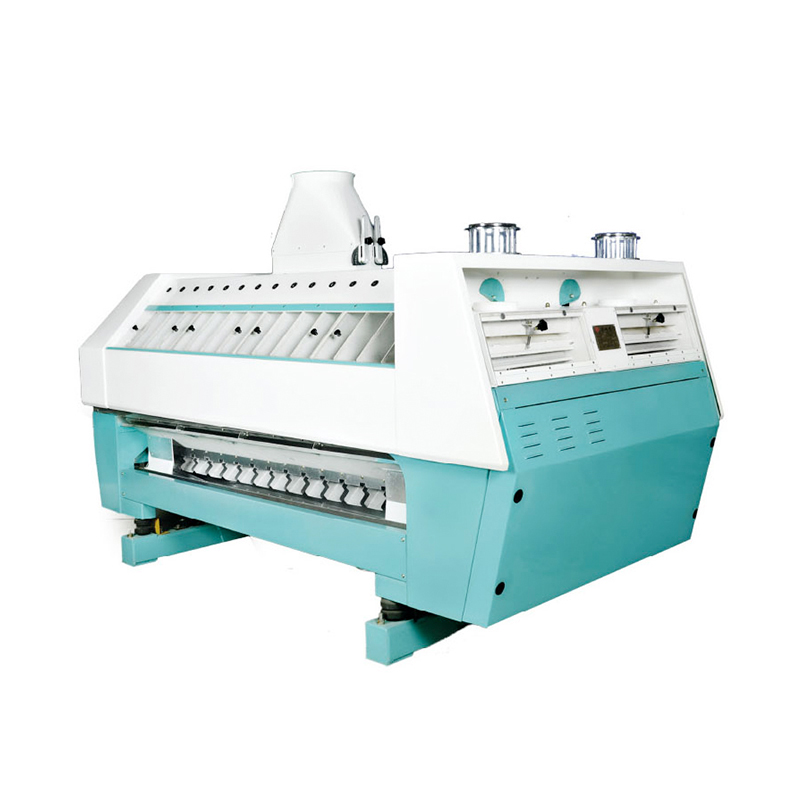
The core principle relies entirely on stratification. It utilizes a fluid-bed dynamic across the machine deck. Heavy, pure endosperm settles rapidly to the sieve surface. Meanwhile, lighter bran particles float to the top of the material bed. This vertical layering is essential for clean extraction.
Modern equipment executes this separation using a precise triad of forces.
Mechanical Sifting: The machine utilizes variable mesh sizes. These screens filter particles strictly by their geometric dimensions.
Vibratory Action: Eccentric drives continuously shake the sieve frames. They evenly distribute the stock across the entire deck. This shaking induces the vital density-based layering.
Controlled Aspiration: Fans generate upward air currents. Operators tune these currents to specific deck zones. The air lifts lightweight bran upward. It removes the bran without carrying away your valuable endosperm.
Understanding the step-by-step material flow clarifies the entire process. The journey follows a strict operational sequence.
Feed mechanisms distribute the incoming stock uniformly across the inlet section.
The initial deck area extracts the heaviest, cleanest endosperm immediately.
Material moves forward, undergoing progressive separation along the subsequent sieve decks.
Aspiration continually lifts lighter fractions into overhead collection channels.
The machine collects the final tailings at the end of the deck for reprocessing.
Grain characteristics dictate your entire purification strategy. Soft wheat processing presents distinct realities. This grain is highly friable. It shatters easily during the initial break stages. Because it breaks so readily into fine flour, it requires less aggressive purification. Many mills process soft wheat relying primarily on standard sifters.
Hard wheat introduces stricter requirements. The endosperm remains intact longer. It produces coarse chunks during the break process. You must deploy specialized equipment to isolate these coarse particles. Maximizing the extraction of premium, low-ash flour demands precision. Failing to isolate the coarse semolina reduces your overall high-grade yield.
The durum and semolina standard represents the most rigorous application. The separation machine acts as the absolute heart of a durum mill. High-quality pasta production demands pristine, bright yellow semolina. Preventing bran specking is entirely non-negotiable. Consumers immediately reject pasta showing brown flecks. You must enforce strict adherence to ash limits. Premium durum applications typically require an ash content of ≤0.65%.
Wheat Category | Physical Property | Purification Intensity | Typical Ash Target |
|---|---|---|---|
Soft Wheat | Highly friable, shatters easily | Low (Often Sifter-reliant) | ~0.45% - 0.50% |
Hard Wheat | Breaks into coarse chunks | High (Dedicated isolation) | ~0.40% |
Durum / Semolina | Extremely dense, resistant | Maximum (Non-negotiable) | ≤0.65% |
Even the best equipment fails without proper calibration. You must understand the specific risks associated with poor configuration. Two primary failures dominate milling operations.
Oversifting presents severe risks to flour quality. We define oversifting as the result of excessive sieve area. It also occurs when you supply insufficient feed to the machine. The material bed becomes too thin. Airflow bypasses the stock entirely. Fine bran then penetrates the mesh alongside the endosperm. This immediately spikes your ash content. It ruins the final flour grade.
Undersifting destroys your overall extraction yield. We define undersifting as the result of overloaded screens. It also happens when you use undersized mesh. Recoverable endosperm cannot pass through the sieve. It bypasses extraction entirely. This clean material flows directly into the next milling stage. You lose premium product to lower-grade streams.
Adhering strictly to calibration best practices prevents these failures. You must map your sieve setups directly to the break stock granulation size. Ensure the coarsest sieve aperture is sized correctly. A standard industry practice is to set it 60 to 120 microns larger than the upper limit of the incoming particle spectrum. This specific tolerance maintains optimal flow. It guarantees maximum separation efficiency.
Failure Type | Root Cause | Primary Consequence | Calibration Fix |
|---|---|---|---|
Oversifting | Insufficient feed or excessive sieve area | Ash content spikes, flour grade drops | Increase feed rate or reduce sieve aperture |
Undersifting | Overloaded screens or undersized mesh | Yield loss, endosperm escapes to next stage | Decrease feed load or increase sieve size |
Selecting the right equipment upgrades requires careful evaluation. You must prioritize specific mechanical capabilities. Airflow precision and balancing stand out as the most critical factors. Buyers should demand independently adjustable aspiration chambers. Airflow represents the most sensitive variable in the entire process. Poor aerodynamic design leads to inconsistent fluidization. This inconsistency destroys your stratification efforts.
Sanitation and maintenance features require equal attention. You must look for fully enclosed, food-safe designs. Assess features like self-cleaning sieve mechanisms. Continuous brush systems effectively prevent mesh blinding. LED-illuminated product chambers offer significant operational advantages. They allow operators to monitor stratification visually. You can observe the material bed without opening sealed panels.
Vibration dampening determines the machine's long-term reliability. You must evaluate the structural integrity closely. Look for equipment utilizing hollow rubber spring mounts. Rigid aluminum frames also provide superior performance. These components isolate the intense vibration. They ensure consistent eccentric motion. Crucially, they achieve this without fatiguing your facility's surrounding infrastructure.
Customization and scalability future-proof your investment. A reputable Purifier manufacturer will consistently offer modular sieve configurations. They will also integrate variable speed drives into their designs. These drives allow millers to adapt the machine parameters quickly. You can adjust settings to match fluctuating grain profiles. This flexibility helps you effortlessly manage seasonal crop variations.
A modern separation system is not merely a basic filter. It operates as a vital revenue-protection asset. It continuously balances your extraction yield against strict ash-content limitations.
You can optimize your plant operations by following these practical next steps:
Audit your current oversifting and undersifting ratios across all active break streams.
Review your durum and hard wheat ash specifications against premium industry benchmarks.
Map your incoming particle spectrum to ensure your coarsest sieves maintain the necessary 60 to 120-micron clearance.
Consult with equipment engineers to discuss upgrading any outdated aspiration controls.
A: High-quality patent flour derived from pure endosperm typically targets an ash content of around 0.40%, while premium durum semolina requires ≤0.65%.
A: Sieve setups must map directly to the granulation size of the break stock. A standard industry practice is to set the discharge sieve aperture roughly 60 to 120 microns larger than the maximum particle size of the target material.
A: Sieves only separate by size. Aspiration acts on specific gravity (density), lifting small but lightweight bran particles that would otherwise fall through the sieve mesh alongside similarly sized endosperm.
